On Thursday morning, September 3, 2026, the digital world ground to a sudden halt.
Across the globe, millions of people who rely on artificial intelligence for daily tasks hit a brick wall. Engineers lost their coding assistants, writers lost their research partners, and businesses found their automated workflows completely frozen.
ChatGPT refused to load. Claude returned unexpected gateway timeouts. Grok told users it was temporarily unavailable. Even secondary developer tools like Cursor suffered severe downtime because their underlying APIs vanished overnight.
Additionally: Cursor's own status history recorded separate September 3 incidents involving all Grok models, upstream Anthropic models, and upstream OpenAI models. GitHub also recorded degraded Grok availability in GitHub Copilot's AI model providers, explicitly attributing that incident to an upstream model provider.

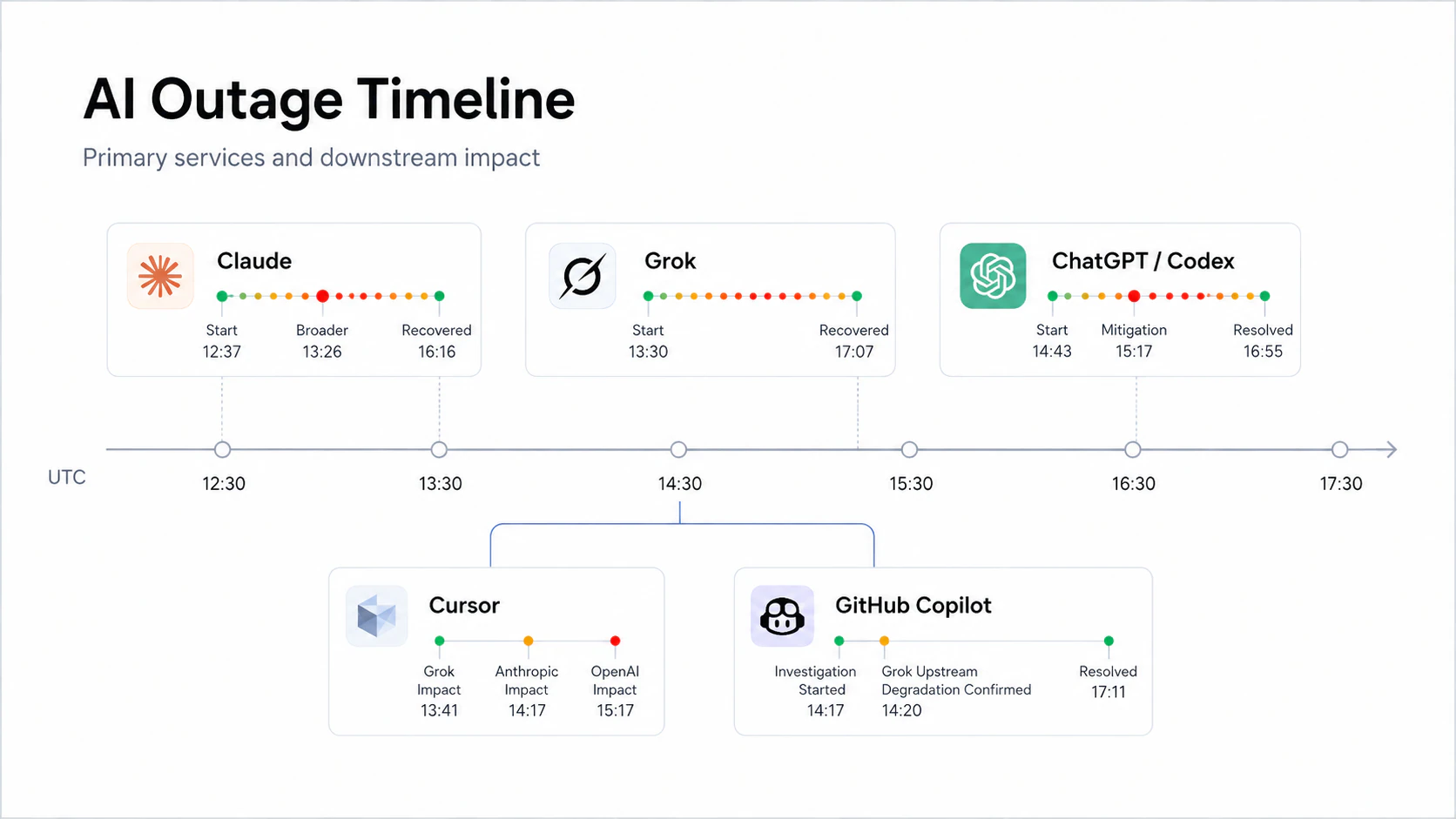
Timeline of overlapping ChatGPT, Claude and Grok outages on September 3, 2026.
When independent tech giants fail at the exact same time, internet panic follows quickly. Did the AI bubble just burst? Was the global power grid under attack?
Let us separate the wild rumors from the actual facts.
The Astra Conspiracy
The drama started hours before the servers went dark. OpenAI's official social media accounts posted a cryptic message: "The stars are almost aligned."
Source: The original ChatGPT post is available on X.
Because rumors had been swirling about OpenAI's next-generation model (codenamed Astra or GPT-6), online communities went wild. When the blackout hit shortly after, people immediately connected the dots. Did OpenAI deploy a massive new model that overloaded the shared computing grid and dragged its competitors down with it?
It makes for a great science fiction story. But the official postmortems paint a very different picture.
What changed only hours later
Later on September 3, OpenAI officially announced GPT-6 Astra, so the model itself is no longer a rumor. OpenAI also published a GPT-6 Astra safety overview describing it as the company's first broadly deployed model to reach the Critical cybersecurity capability threshold under its Preparedness Framework.
That makes the timing of the teaser and the outage unusually dramatic, but it still does not establish causation. OpenAI's explanation for its service disruption was a routing error, and no official report from OpenAI, Anthropic, or xAI has said that the Astra rollout caused the multi-provider outages. Contemporary reporting from WIRED and The Register likewise found no confirmed shared cause.

Source: https://x.com/ChatGPT/status/2095527989077557738
Timelines and Official Incident Reports
Despite the intense overlap, no single unified root cause has been officially declared to link every platform together. Each company released separate explanations for their downtime.
Here is how the incident unfolded across the official status pages (all times in UTC):
12:37 UTC (Claude): Anthropic logged elevated errors on Claude Sonnet 5. They deployed a quick fix, but a broader infrastructure issue hit at 13:26, impacting multiple models including Opus 5, Opus 4.8, and Mythos 5.1. Most services recovered by 16:16 UTC.
Official sources: Claude Sonnet 5 incident · Claude multi-model incident · Claude status
13:30 UTC (Grok): xAI experienced a massive service disruption that lasted nearly three and a half hours, finally resolving around 17:05 UTC.
Official sources: xAI API incident · xAI status · SpaceXAI's public explanation
13:43 UTC (ChatGPT & Codex): OpenAI suffered a routing failure across web, mobile, and desktop platforms. They implemented a mitigation by 15:17 UTC and formally marked the incident resolved at 16:55 UTC.
Official source: OpenAI — Elevated errors across ChatGPT and Codex · OpenAI status
Timestamp verification note: OpenAI spokesperson Kathleen Chaykowski told WIRED that the routing error began at approximately 7:43 a.m. PT, which is 14:43 UTC, and OpenAI's incident page also shows its investigation beginning at 14:43 UTC. The 13:43 UTC timestamp above therefore appears to be one hour earlier than the strongest available primary/reporting evidence. The original line has been left intact here, but 14:43 UTC is the safer timestamp to publish as the verified start time. The mitigation at 15:17 UTC and resolution at 16:55 UTC match OpenAI's status reporting.
Mid-Morning (Gemini): Google AI Studio users reported disruptions with newly created API keys. However, Google did not log a comparable system-wide outage on their official Cloud status dashboard.
Verification: Google did not record a September 3 outage for Gemini on the Google Workspace Status Dashboard, and no comparable broad severe incident appeared on Google Cloud Service Health. User-reporting services and some news outlets still recorded Gemini complaints, so the safest description is reported disruption, not a confirmed Google-wide outage. WIRED and Forbes both documented that distinction.

Independent status pages show the overlap, but not a single shared root cause
Debunking the Shared Failure Rumors
When competitors fail simultaneously, developers immediately look for a shared dependency in the technical stack.
Rumor 1: Cloudflare Crashed
Because Cloudflare sits in front of huge portions of the web, many suspected a central DNS or CDN failure. However, Cloudflare explicitly denied this, stating that their infrastructure operated normally with no significant disruptions during that window.
That denial is supported by a direct statement Cloudflare gave to The Register, saying it was not experiencing a significant service disruption.
But Cloudflare did have smaller R2 and HTTP incidents
Cloudflare's network was not literally incident-free that day. Its incident history shows several minor or localized events around September 3:
R2 buckets in Western North America saw elevated 503 errors between roughly 01:04 and 01:28 UTC.
Some traffic landing in Seattle saw elevated HTTP 522 errors earlier in the morning.
Cloudflare recorded increased HTTP 5xx errors and latency in Hong Kong, resolved by 09:36 UTC.
A longer-running HTTP/3 issue affecting R2 custom domains could cause delayed or failed asset loads for some Firefox users. A fix was being monitored on September 3 and the incident was resolved at 19:32 UTC.
Cloudflare also had routine scheduled datacenter maintenance in several locations, where traffic could be rerouted and latency could briefly increase.
These incidents matter for completeness, but none has been identified as the cause of the ChatGPT/Claude/Grok overlap. The R2 503, Seattle 522, and Hong Kong 5xx events were either earlier or geographically limited; the HTTP/3/R2 issue had a narrow failure mode; and Cloudflare itself said there was no significant platform-wide disruption. In other words, Cloudflare had minor maintenance and service issues, but there is currently no evidence that they caused this AI blackout.
Cloudflare references: Current status · Incident and maintenance history · R2/HTTP incident history

Cloudflare status history showing localized R2 and HTTP incidents on September 3, 2026.
Rumor 2: A Massive Hyperscaler Outage
Some suspected a regional crash in Microsoft Azure or AWS. While minor spikes were reported on third-party outage trackers, neither cloud provider confirmed a major infrastructure failure capable of taking down all three AI giants at once.
This is an important distinction because some breaking-news reports initially pointed toward Azure based on user-reported spikes. Later reporting from WIRED and The Register noted that the major infrastructure providers did not show a relevant confirmed outage capable of explaining all three failures. A Downdetector spike can be a useful signal, but it is not the same thing as a provider-confirmed root cause.
Infrastructure status pages: AWS Health · Microsoft Azure Status · Google Cloud Service Health · Cloudflare Status
Rumor 3: The SpaceXAI Memphis Connection
This is where things get genuinely interesting. xAI officially confirmed that Grok went offline due to an outage at their Memphis compute center. But in their public apology, xAI specifically mentioned apologizing to their "impacted compute partners."
This single sentence raised eyebrows across the tech industry. Does xAI share raw compute infrastructure with other AI leaders? Neither Anthropic nor OpenAI has confirmed relying on Memphis, but it leaves an open question about how deeply connected these backend data centers really are.
One part of the Memphis connection is actually confirmed
Anthropic's relationship with xAI/SpaceXAI compute is not entirely speculative. On May 6, 2026, SpaceXAI publicly announced a compute partnership with Anthropic, giving Anthropic access to Colossus 1 to improve capacity for Claude Pro and Claude Max subscribers. SpaceXAI separately identifies Colossus as its South Memphis supercomputing facility.
What remains unconfirmed is the crucial causal link: neither company has said that Anthropic's September 3 outage was caused by the Memphis failure. OpenAI has also not confirmed any dependency on the Memphis facility. So the strongest defensible conclusion is:
xAI/SpaceXAI ↔ Anthropic compute sharing: confirmed.
Memphis outage ↔ Grok outage: confirmed.
Memphis outage ↔ Claude outage: plausible but unconfirmed.
Memphis outage ↔ ChatGPT/OpenAI outage: unconfirmed, with OpenAI instead citing its own routing error.
This nuance is also highlighted in WIRED's reporting.
What This Outage Teaches Us
This was not an AI bubble bursting. The neural networks did not suddenly break or lose intelligence. This was a classic lesson in system architecture.
We often imagine AI companies as completely isolated islands:
OpenAI builds GPT.
Anthropic builds Claude.
xAI builds Grok.
In reality, while they compete aggressively at the top software layer, they rely on the exact same foundation at the bottom: shared fiber networks, data centers, hardware suppliers, and routing protocols.
When I wrote recently about going back to computer science fundamentals, this is precisely the reality I explored. No matter how advanced software becomes, it still runs on physical hardware, routing tables, and network switches. If a regional routing layer glitches or a compute cluster drops offline, even the most sophisticated AI on earth goes silent.
Related reading on this site: I Stopped Chasing Tech Stacks and Started Learning Computer Science Again · The Y2038 Time Bomb and Why Data Representation Matters
There is another engineering lesson here as well: dependencies propagate. Cursor's status page showed how outages at OpenAI and Anthropic immediately surfaced as failed Agent turns in a separate product, while GitHub Copilot reported degraded Grok models because of an upstream provider. Even if two products are operated by different companies, they can still share enough infrastructure, model APIs, compute suppliers, or network paths to create correlated failure.
You can read more about my work and writing over at sanchit.pro.
Portfolio: sanchit.pro
Bottom line
The outages were real and heavily overlapped, but the evidence still supports separate documented incidents rather than one confirmed shared failure. The strongest infrastructure link currently known is the existing SpaceXAI–Anthropic compute partnership, but that alone does not prove that the Memphis outage caused Claude's disruption.
What Do You Think?
Was this simultaneous blackout just an extraordinary, one-in-a-million coincidence where three separate routing and infrastructure bugs hit within the exact same hour? Or are these competing AI platforms far more intertwined under the hood than any of them want to admit?