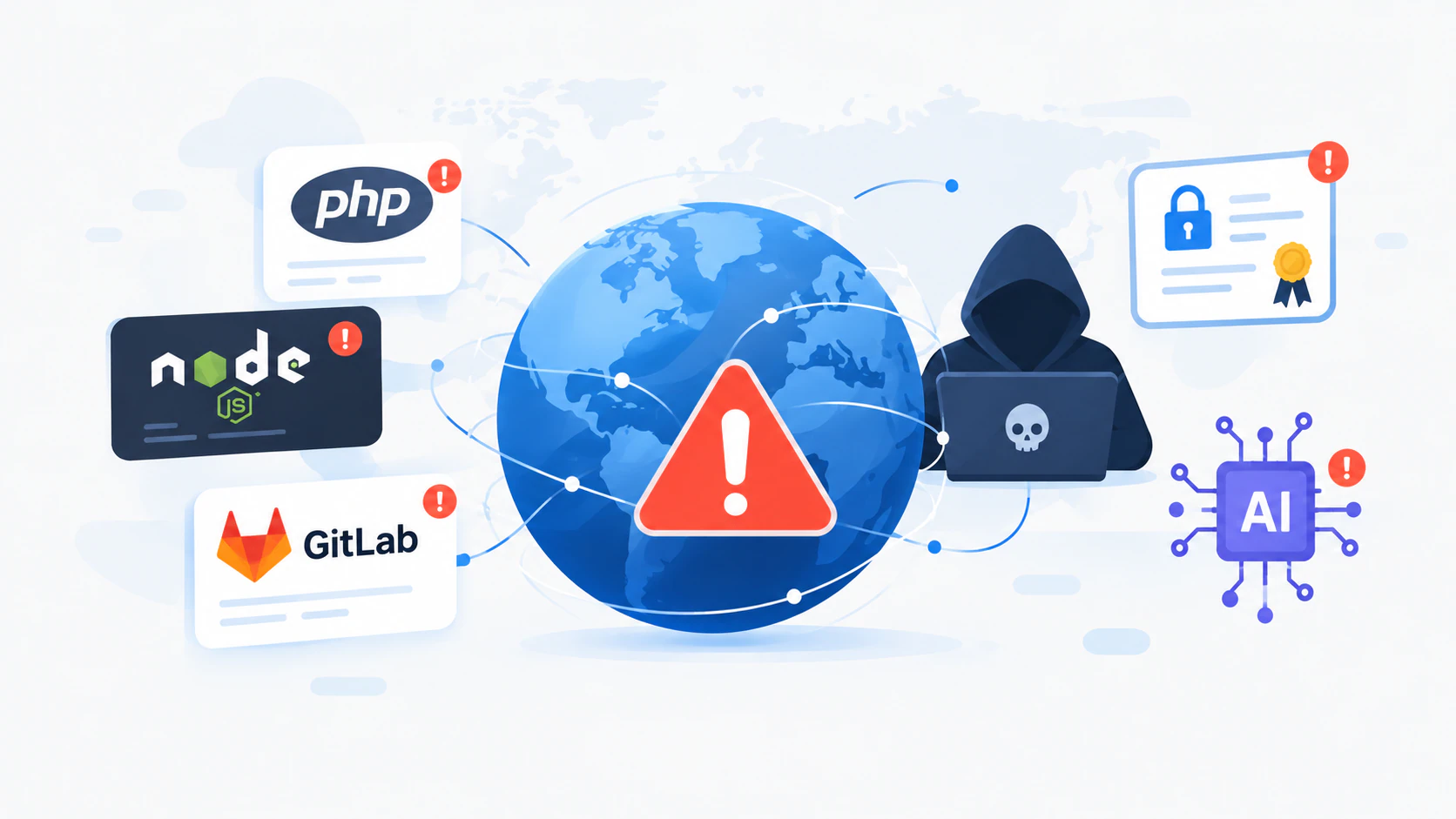
October 2026 has delivered a serious reminder that the internet can be vulnerable even when everything appears to be working normally. Critical flaws have emerged in PHP and Node.js, security updates have drawn attention across developer platforms, and an incident involving digital certificate keys has raised questions about how browsers decide which websites to trust.
What makes this month especially interesting is the role of AI-assisted security research. AI tools are increasingly helping researchers investigate complex bugs, but the same technological progress raises another question: what happens when vulnerabilities can be discovered and exploited faster than organizations can fix them?
Here are the major developments, their potential impact, and what developers and website owners should know.
1. PHP2Shell: A flaw that could put websites at risk
On October 21, two critical PHP vulnerabilities, CVE-2026-109618 and CVE-2026-109619, became public under the name PHP2Shell.
PHP powers a huge number of websites, including WordPress sites, online stores, and business applications. These vulnerabilities involve memory-management errors that could allow an unauthenticated attacker to execute malicious code on a vulnerable server.
Imagine a website as a restaurant. PHP is the kitchen processing incoming orders. A carefully crafted request could exploit a flaw in how the kitchen handles an unexpected error, allowing an attacker to interfere with the system itself.
What could be affected? A vulnerable website could face service disruption, unauthorized changes, or exposure of sensitive application data. Depending on the server's permissions, an attacker might also reach database credentials or other secrets.

Cloudflare reported deploying protective firewall rules around the disclosure period. However, firewall protection is an additional layer of defence, not a replacement for updating PHP.
What to do: Website owners and hosting providers should check their PHP versions and apply the appropriate security updates.
Read Cloudflare's PHP2Shell technical coverage and the official Canadian cybersecurity advisory.
2. Node.js: Security flaws affecting applications and servers
On October 21, Node.js released security updates across its 22.x, 24.x, and 26.x release lines.
One of the most serious issues was CVE-2026-111497, a vulnerability in the Brotli decompression component. Under the relevant conditions, malicious compressed input could cause memory corruption and potentially allow remote code execution.
In simple terms, decompression is how an application unpacks compressed data. If the software mishandles that data, an attacker may be able to do more than simply send a malformed file.
Other vulnerabilities affected DNS resolution and TLS certificate verification. For example, CVE-2026-105482 involved hostnames containing a special null character being handled incorrectly. Other certificate-validation flaws could cause certain unusual hostname formats to be validated incorrectly.
What could be affected? Backend APIs, SaaS platforms, and services processing untrusted compressed data may be exposed to different risks depending on their configuration. Certificate-validation issues could also affect applications connecting to external services.
Imagine an application connecting to a payment provider. If it incorrectly validates the destination's identity, it could potentially trust the wrong endpoint under the affected conditions.
What to do: Developers should update to the appropriate patched Node.js release and review their dependency trees.
Read the official Node.js October security release.
3. GitLab: Why developer infrastructure matters
GitLab security updates are another important reminder that developer infrastructure is part of an organization's security boundary. Git repositories, deployment pipelines, credentials, and build systems can all become attractive targets.
A vulnerability in a self-managed development platform can have consequences beyond the platform itself. If an attacker compromises a system holding source code or deployment credentials, the risk may extend to the applications built and deployed through it.
What could be affected? Source code, internal project information, CI/CD secrets, and connected deployment infrastructure may be at risk if a vulnerable installation is successfully compromised. These are potential consequences, not proof that every affected installation suffered a breach.
What to do: Administrators should review official GitLab security advisories, install applicable patches, and investigate suspicious login activity, pipeline changes, and unexpected access to secrets.
Start with GitLab's official security releases.
4. eMudhra: When a private key was just the number 4
One of October's most striking security incidents involved eMudhra, a provider of digital certificates used to establish trust online.
Researchers discovered that eight intermediate certificate authority private keys were dangerously weak. One of them was simply 4, while the other seven were also tiny numbers below 256.
To understand why this matters, think of a digital certificate as an identity document for a website. Browsers use certificates to help verify that a website is genuine rather than an impostor. Certificate authorities help establish that trust.
If an attacker obtains a certificate authority's private key, they may be able to create fraudulent certificates that impersonate websites or services.

How weak were the keys?
A private key should be a secret number selected securely from an enormous range of possibilities. For a properly generated private key, the number of possible values is approximately (10^{115}).
Instead, the eight affected keys were all below 256.
The difference is staggering.
A private key can be represented as a long, unpredictable number:
Illustrative example: 7... [many unpredictable digits] ...93
One of the affected keys was simply:
4
The long number above is illustrative and is not an actual private key.
This was not encryption being broken. The problem was that the keys had been generated with dangerously weak values. Someone could recover such a key by testing a tiny number of possibilities instead of attempting to guess a properly generated cryptographic secret.
What could have been affected?
The incident raised concerns across several areas:
HTTPS websites: Fraudulent certificates could potentially be used to impersonate domains if the affected keys were trusted.
APIs and backend services: Applications relying on outdated certificate trust stores might continue trusting affected certificates.
Older systems and containers: Custom or bundled certificate lists might not receive browser security updates automatically.
Digital trust infrastructure: The incident demonstrated how a key-generation failure at a trusted certificate authority can create risks far beyond one website.
Browser vendors took action to block the affected certificates. However, systems with custom trust stores or outdated software may require separate updates.
eMudhra stated that the affected intermediate certificates had not been used to issue end-entity certificates. This is important context: the weak keys created a serious security risk, but it does not mean every website using digital certificates was compromised.
The lesson: Strong encryption is only as reliable as the keys behind it. Even sophisticated cryptographic systems can fail when secrets are generated incorrectly.
Read Cloudflare's detailed explanation of the eMudhra certificate incident.
5. Where does AI fit into all this?
AI is becoming part of both sides of cybersecurity. Researchers can use AI-assisted tools to inspect code, identify unusual behaviour, and investigate vulnerabilities. Attackers can also use automation to test systems and adapt malicious inputs.
There is a concrete connection in this month's Node.js disclosures: the official security release credits OpenAI Codex Security researchers with reporting CVE-2026-111497.
That does not mean AI independently discovered every vulnerability mentioned here, or that AI caused these incidents. It demonstrates how AI-assisted security research is becoming part of modern software development.
The bigger concern is speed. Discovering a vulnerability is only one stage. Developers must understand it, prepare a fix, deploy updates, and verify that systems are protected before attackers take advantage of the weakness.
AI can help researchers move faster, but it also makes secure development practices, timely patching, and responsible disclosure more important.
October 2026 cybersecurity timeline
October 17: A report is submitted to browser security teams concerning weak eMudhra intermediate certificate keys.
October 19: Cloudflare becomes aware of the eMudhra incident and begins deploying protective measures.
October 20: Cloudflare publishes its explanation of the certificate incident and outlines customer actions.
October 21: PHP2Shell is publicly disclosed, and PHP security updates are announced.
October 21: Node.js publishes security updates addressing several vulnerabilities, including the Brotli decoder flaw.
October 23: Additional information about PHP's security situation is published, including another reported vulnerability requiring separate attention.
What should developers and website owners do now?
The incidents differ, but the immediate response follows the same principles:
Update affected software: Check PHP, Node.js, GitLab, and other internet-facing components against their official advisories.
Review dependencies: Applications can inherit vulnerabilities through runtimes, libraries, container images, and bundled certificate stores.
Investigate suspicious activity: Look for unexpected processes, unusual authentication events, unexplained pipeline changes, or abnormal outbound connections.
Refresh certificate trust: Update operating systems, runtimes, containers, and custom trust stores where required.
Do not disable security checks: If a certificate error appears after an update, investigate and fix the trust configuration rather than disabling certificate verification.
Final thoughts
October's cybersecurity developments show that serious vulnerabilities can appear in the foundations of everyday internet services: the runtime processing a website request, the software connecting applications to other systems, the platform storing source code, or the certificate infrastructure that helps establish trust.
For developers, the lesson is to monitor official advisories, update dependencies and runtimes, and treat security as an ongoing responsibility. For website owners, it is worth checking with hosting providers that critical updates have been applied. For everyone else, keeping browsers, operating systems, and applications updated remains an important basic precaution.
AI is adding new capabilities to security research, but it does not remove the need for careful engineering, responsible disclosure, and timely patching. In the end, the strongest security response is not simply discovering a vulnerability first. It is making sure that the systems depending on the affected software are protected.
This article reflects publicly available reports and advisories as of October 24, 2026. Actual exposure depends on software versions, configuration, and deployment conditions.
More from Sanchit
Want to explore more about AI and the technology behind today's digital services?
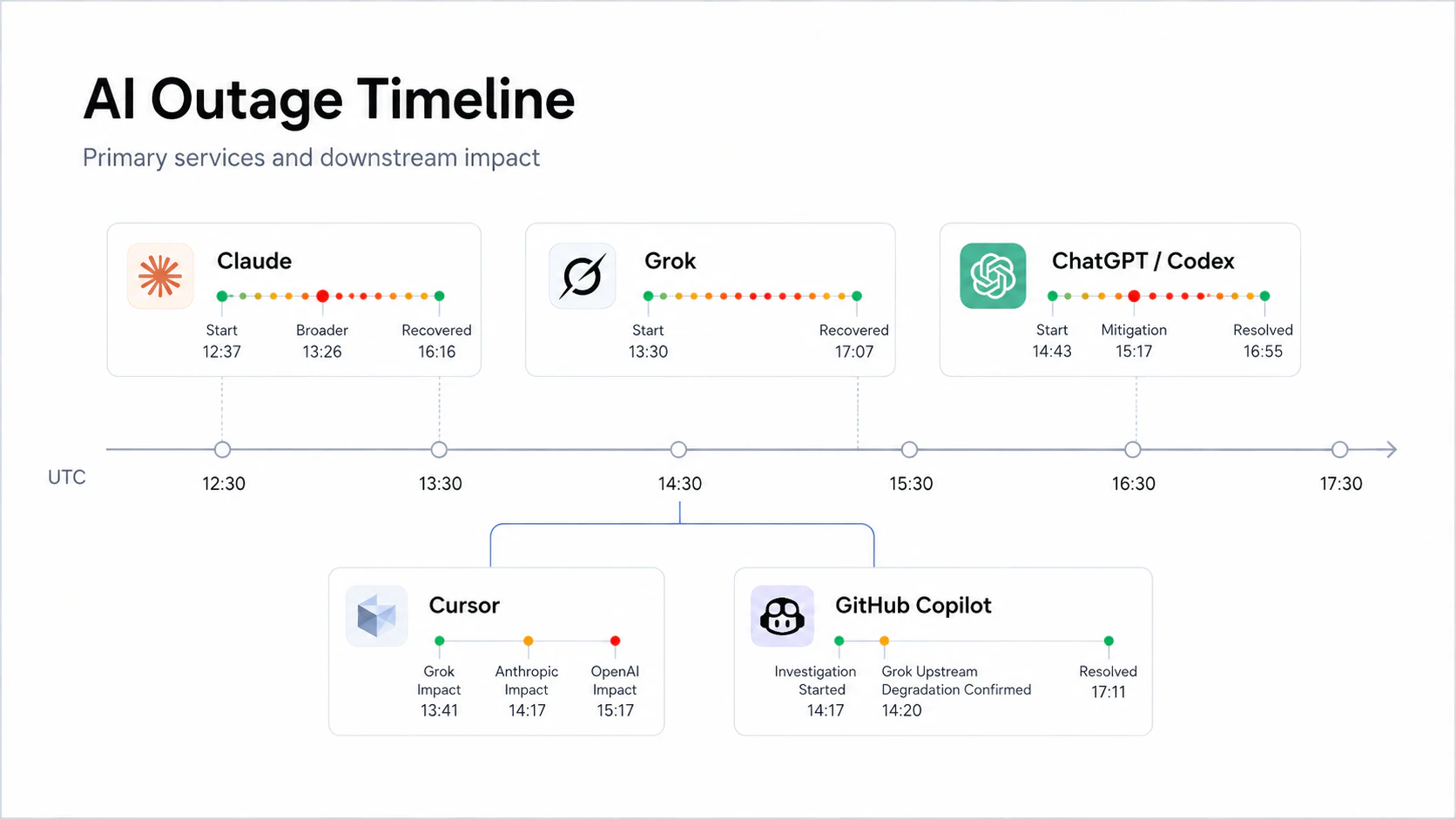
Read my article, The Great AI Outage of 2026: What Happened?, for another look at the reliability challenges facing modern AI systems.
Explore more articles on the sanchit.pro.